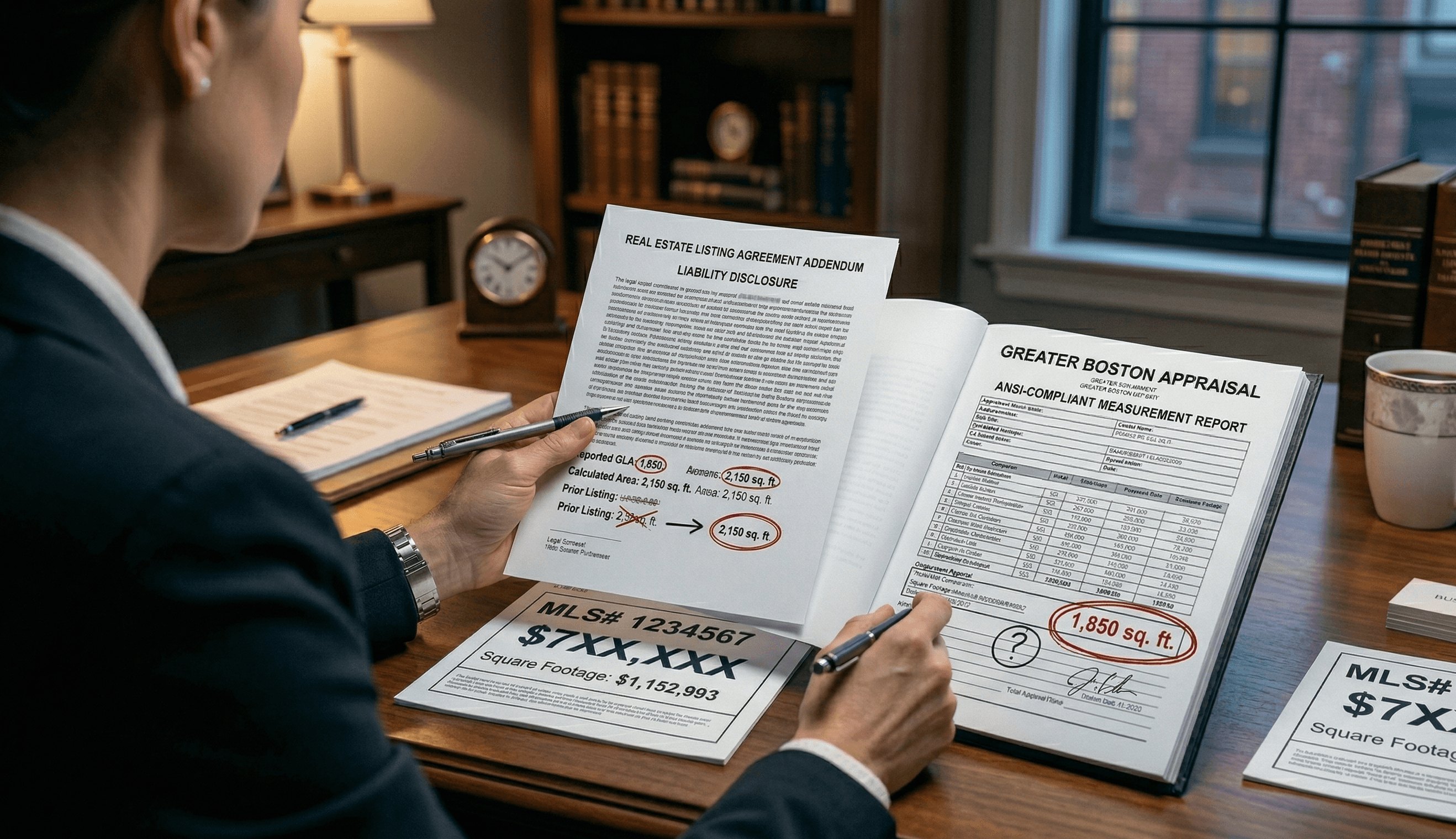

Most real estate agents know they should verify square footage before listing. Most also know that in practice, this rarely happens the way it should. The number gets pulled from the tax record, copied from the prior listing, or estimated from a builder plan. The listing goes live. The deal closes. And in the vast majority of cases, nothing happens. But in the cases where something does happen where the number turns out to be materially wrong, and a buyer paid a price anchored to that number, the legal and regulatory consequences for the listing agent can be severe.
The measurement standard agents must now comply with has a name, the ANSI Z765 standard that Fannie Mae made mandatory for all property measurements is what defines a defensible square footage number in today's real estate environment.
The Legal Standard: Square Footage Is a Material Fact
Courts and real estate regulatory bodies have consistently treated square footage as a material fact in real estate transactions. A material fact is one that a reasonable buyer would consider important in their decision to purchase, and at what price. Courts have ruled that misrepresentation of a material fact, even an unintentional one, can give rise to liability.
In the landmark case Horiike v. Coldwell Banker, the California courts sided with a buyer who had relied on inflated square footage in the listing. The agent had overstated GLA and failed to correct it when the discrepancy was discovered. The ruling established that listing agents can be held responsible for inaccurate square footage figures they advertise, not just for intentional misrepresentation, but for failing to exercise reasonable diligence.
The defense, "I got it from the tax records, " has not protected listing agents in court. The courts have made clear: if you publish the number, you own it. If you're the expert, you have a duty to be accurate. A professional measurement is not an extravagance; it is your protection.
The MLS Fine You May Not Know About
Beyond civil liability, most Multiple Listing Services carry explicit rules about data accuracy, including square footage. MLS fines for advertising inaccurate square footage typically range from $200 to $1,500 per violation. In cases of repeated violations, suspension or revocation of MLS access is possible.
More critically, an MLS violation finding can be submitted to the state real estate licensing board as evidence of a pattern of misrepresentation. In Massachusetts, that can trigger a licensing review, a formal complaint investigation, and, in serious cases, disciplinary action against the agent's license.
The Cascading Error Problem
Square footage errors do not affect only the transaction in which they originate. When an incorrectly measured comparable sale enters the MLS database, it becomes data that appraisers use for future comparable sales analysis. An inflated GLA figure in a sold comparable inflates the appraiser's per-square-foot adjustment calculation, which produces inflated values for properties compared against it. A single bad measurement can distort market data for years.
This is not hypothetical. A published North Carolina Real Estate Commission case study documented exactly this chain of events: a square footage error in a listing affected two comparable sales used in subsequent appraisals, producing incorrect market values across multiple transactions in the same neighborhood.
Compliance requires understanding not just how to measure but what qualifies, what actually counts toward official square footage and what gets excluded is the classification question that trips up agents who measure square footage without ANSI training.
The Professional Measurement as Complete Protection
An agent who lists a property using a professionally produced, ANSI-compliant floor plan measurement, one commissioned from a certified appraiser and documented with a physical inspection record, has done their due diligence. When the buyer's lender's appraiser independently measures and arrives at the same figure, there is no discrepancy, no appraisal gap, no trigger for legal review. The number is right because it was measured correctly, and there is documentation proving it.
The risk does not just come from agent estimates, what happens to a deal when public records have the wrong square footage is a documented case where a 400-square-foot discrepancy nearly derailed a refinancing appraisal.
Ready to Get Started?
Whether you are a homeowner, real estate professional, interior designer, or investor, the Aladdin Appraisal team delivers professional, ANSI-compliant floor plan measurements and property sketches you can rely on for any purpose.
Phone: (617) 517-3711
Email: info@aladdinappraisal.com
Web: www.aladdinappraisal.com