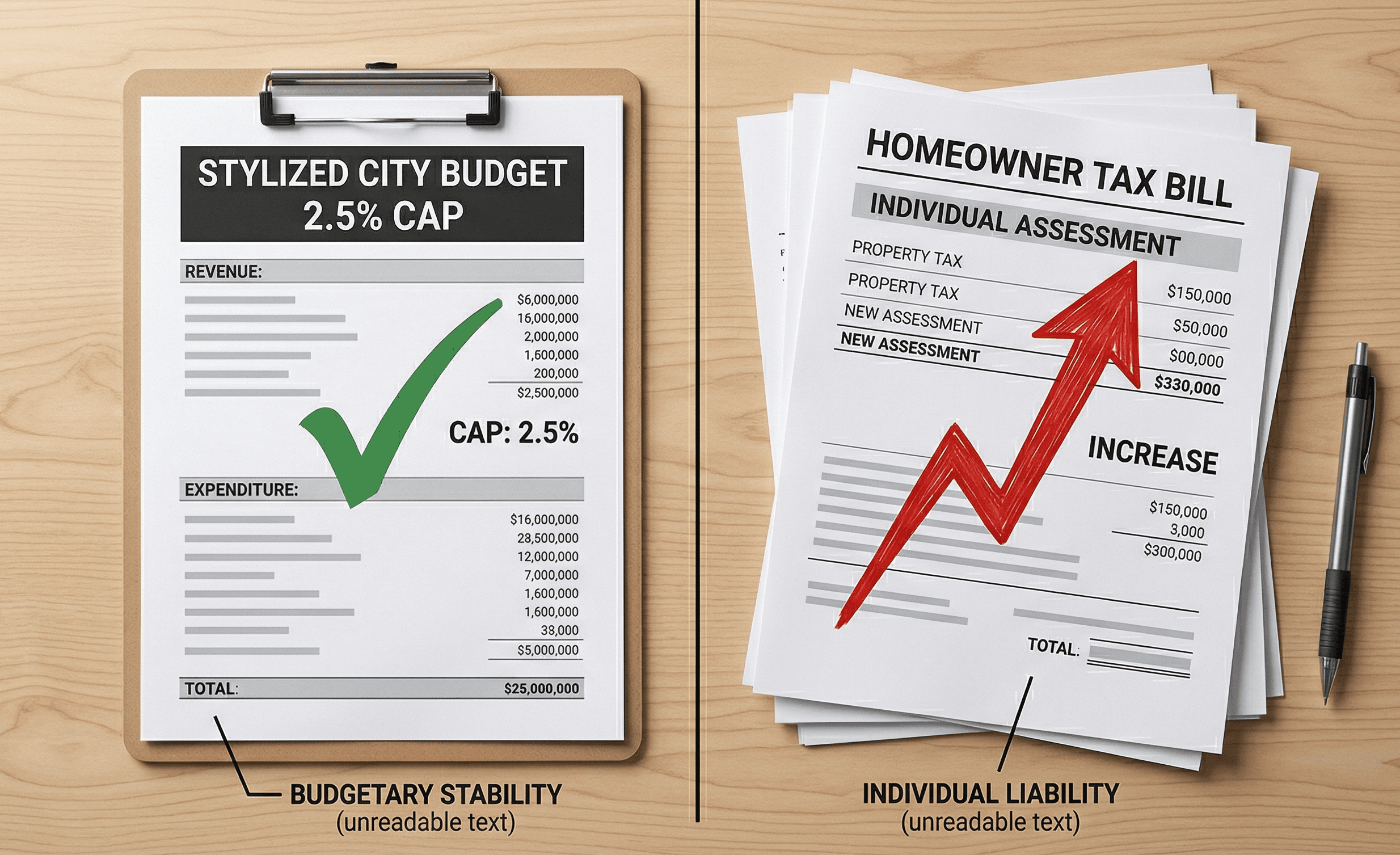

Massachusetts homeowners have a false sense of security about their property taxes that stems from a fundamental misunderstanding of Proposition 2½. They know that Proposition 2½ limits how much municipalities can raise in total property tax revenue each year. They assume this means their individual property tax bill is similarly constrained. It is not. And this misunderstanding causes many homeowners to accept tax increases that they have every right to challenge.
Whether or not Prop 2½ applies to your situation, the formal remedy is the same, how the property tax abatement process works in Massachusetts is the step-by-step guide to filing and what evidence is required to win.
What Proposition 2½ Actually Does
Proposition 2½, passed by Massachusetts voters in 1980, limits the total property tax levy, the aggregate amount a municipality can collect from all property taxpayers combined, to 2.5 percent of the total assessed value of all taxable property in the community. Annual increases in the total levy are capped at 2.5 percent, plus an allowance for new growth from new construction.
What Proposition 2½ does not do is limit what happens to any individual property's assessment. A town can increase one property's assessed value by 40 percent and decrease another's by 20 percent as long as the total levy stays within the law's parameters. In practice, this means that revaluations can dramatically redistribute the tax burden among property owners without any overall increase in what the town collects.
Proposition 2½ is a ceiling on what the town can collect in total. It is not a ceiling on what the town can assess your property at. If your home's assessed value rises faster than your neighbors' because of a market shift, a revaluation methodology change, or an uncorrected error, your share of the capped levy increases. The cap protects the town's budget, not your individual tax bill.
This is part of a larger structural problem, why you are probably overpaying property taxes and how the system works against finding out is the broader context behind individual assessment errors under any tax limitation formula.
The Revaluation Redistribution Effect
Massachusetts municipalities are required to conduct periodic revaluations, comprehensive updates of all property assessments to reflect current market conditions. When a revaluation occurs, the new assessments are supposed to reflect market value as of the valuation date. But revaluations are not perfectly uniform. Some property types or neighborhoods may be reassessed more aggressively than others, producing a redistribution of the tax burden even when the total levy does not increase.
In gentrifying neighborhoods, communities where some properties have appreciated dramatically while others have not, the redistribution effect can be particularly pronounced. A homeowner in a gentrifying neighborhood who has not renovated, and whose home has not appreciated as dramatically as the surrounding market might suggest, may find their assessment disproportionately increased simply because the assessor's model has absorbed the neighborhood's overall trend.
The January 1 Valuation Date and Why It Creates Appeal Opportunities
Massachusetts assessments are based on the market value of a property as of January 1 preceding the fiscal year. For Fiscal Year 2026 (which runs July 1, 2025, to June 30, 2026), the valuation date is January 1, 2025.
This creates a specific, bounded question for any tax appeal: what was this property worth on January 1, 2025? Not what it is worth today. Not what it was worth at the peak of the market. What was its fair cash value on that specific date? A certified appraiser who can produce a USPAP-compliant retrospective opinion of value as of January 1, 2025, drawing on comparable sales from calendar year 2024, is providing exactly the evidence Massachusetts law requires.
When the Market Has Moved Against the Assessment
If the local market softened between the comparable sales period used by the assessor and the valuation date, if interest rates increased, reduced buyer demand, if inventory increased, or if prices declined in a specific neighborhood, the assessor's model may have produced an assessment that is higher than the market would actually support as of January 1.
In these circumstances, a professional appraiser who analyzes sales data from the correct period and applies careful time adjustments can demonstrate that the assessed value exceeds fair cash value the precise legal standard for a successful abatement.
The date-based nature of Massachusetts assessments connects to the data behind the number, the assessment field card and the January 1 data used to generate your bill is where most overassessment errors actually originate.
Ready to Get Started?
Whether you received an assessment notice that seems too high, suspect your property has been incorrectly measured, or want to ensure you are not overpaying taxes year after year, the Aladdin Appraisal team provides professional, USPAP-compliant tax appeal appraisals across Greater Boston that the Appellate Tax Board accepts as expert evidence.
Phone: (617) 517-3711
Email: info@aladdinappraisal.com
Web: www.aladdinappraisal.com